All shall be well, and all shall be well, and all manner of thing shall be well.
— St. Julian of Norwich
This is the first post on my new blog. I’m just getting this new blog going, so stay tuned for more. Subscribe below to get notified when I post new updates. More to come soon!
A local Liverpool brewery’s rather appropriately-titled brew!
As promised, a final blog post!
The first thing I had to adjust to in Liverpool was the fact that home was five hours behind. Now that I’m back in Massachusetts, I now have to adjust to my home over in Liverpool being five hours ahead (and I’m sure Debra relishes the fact that she is now constantly ahead of me!).
Leaving Liverpool took some sorting, to say the least. Between tests, courier packages, baggage screenings, and a delayed flight, I was quite happy and tired when I finally arrived in the family home to the nonchalant but positive reception by the family dog, Wilfred (who I think sees me mostly as another source of scratching and feeding. I don’t mind). I’m glad to report that Scruffy and Wilfred get on famously, and the introduction of my Liverpool-acquired soft-toy animal companions with my older has gone swimmingly.
As for what I’m up to, I’m awaiting the outcome of a job interview and exploring additional opportunities as well. I also hope to be continuing academic research opportunities begun in Liverpool, but virtually and at a distance. It will be good to have a continuing project that will tie my recent past with present reality.
A question, to which I know there is a considerable answer, but continually trying to articulate, is, “What have I learned during two years in Liverpool?” The beginning of the answer is probably, “a good deal about myself”: my introverted nature was confirmed, but I also know the value I set on human interaction (something many introverts and we all learned to appreciate during lockdown); I learned that I have a love the daily round of worship; have now an even darker, drier, and unashamedly British sense of humour than I had before; that I maintain a commitment to the divine call, nay mandate, of incarnational justice in the person of Jesus Christ; that I love chocolate digestive biscuits; and, of course, the proper preparation of proper English tea.
I tried to throw myself into my work, and have begun to develop a sense and appreciation of my own abilities, which I remember I found absolutely excruciating during that compliment exercise at missionary orientation.
Life in Anglicanism is life committed to diversity; and I’ve begun to appreciate and find the presence of the Divine in a diverse set of locales: the food bank, the altar, the street, the door. Each of these presences informs us about the One of whom they each are but momentary glimpses.
I owe thanks to so many; to the Young Adult Service Corps of the Episcopal Church, the Diocese of Massachusetts, and my parish, St. Mary’s, for their faith in sending me; to the Tsedaqah Community in the Diocese of Liverpool for receiving me; for Liverpool Cathedral and Micah Liverpool for putting me to work; and to all the individuals who make those great and godly institutions what they are.
And to you, who have made this journey with me, and supported me in this journey monetarily and prayerfully.
And, thanks be to God, for his constant faithfulness, and the guidance of the path to which He has called me, and to wherever he will call me in the future.
I can only now commend to you the YASCers who will be making this journey in the coming months; the page to watch out for their blogs will be here: https://www.episcopalchurch.org/YASC/meet-yascers.
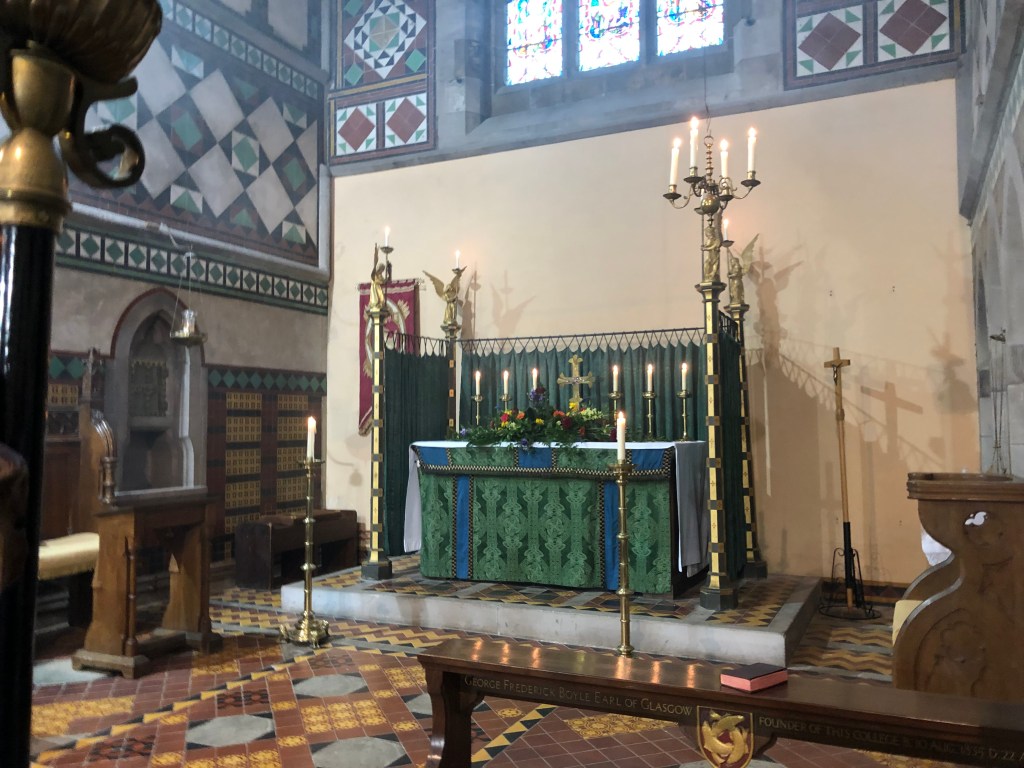
The High Altar of the Cathedral of the Isles, ready for worship!
The first week of August saw members of the Tsedaqah Community driving up to Scotland for the annual community retreat. It was a retreat for both members of the Community from 2019-2020 and 2020-2021, as the community was unable to go on retreat in 2020 for obvious reasons.
We went to an island not far off the coast of Glasgow: the Isle of Cumbrae. We stayed at the Cathedral of the Isles of the Scottish Episcopal Church, the Anglican presence in Scotland. The island is, like my hometown, a tourist destination. It was actually quite fun to play the tourist after being a proper Scouse “townie” in Liverpool!
The Cathedral is the smallest in the United Kingdom, and you could probably fit three of them in the Lady Chapel of Liverpool alone. The Cathedral was more or less ours for the week, as there are no weekday services there. Tsedaqah therefore provided the offices, complete with Organ accompaniment and the sweet smell of incense. (The SEC is quite high in Church of England standards, as the presbyterian Church of Scotland is by definition lower down the candle). No one will be surprised by the fact that I served as a thurifer and often was to be found lighting candles before services. But I followed the ancient saying: “When in Rome, do as the Romans do. When in Cumbrae, burn so much incense that you leave an inch of charcoal dust in the thurible when you leave.”
The island was stunning, with ancient rocky shores and ample heather lining the otherwise forest-covered island, with the exception of the farmland where cattle grazed. Driving around the island was also a de facto tour of the nearby islands, far less inhabited and stunning in their tall green hills and mythic presence shrouded in clouds and mist.
The water, too, was freezing! It’s been a while since I’ve swam in the ocean, and had forgotten how chilly and salty it is. Splashing Debra was also quite fun!
Some of my favourite memories are those in the Cathedral library. Late into the evening we’d stay up, with the musty smell of old books and the warmth of dark wood adding an air of class to the proceedings. I don’t remember who’s idea it was, btu I got my first taste of the British “Carry on” film, a Monty Python-esque absurdist genre, but with less cross-dressing.
The retreat was a time of rest and relaxation in the beauty of creation, yet one of profound personal growth and introspection. It was particularly refreshing to have some time away from the business of Cathedral and Micah Food bank life for a few days.
It also began, for me, the process of taking stock of my time in Liverpool, which comes to an end by my flying home on September 11th. As I write, I’m on the other side of two week’s Annual Leave, which I’ve used to see a few of the sites I’ve yet to visit. (When I moved here and got acclimated, I became a proper townie and went, “local statues? Those are for the tourists!”).
Liverpool has become a bit of home, and I’m now preparing for feeling homesick when I go home! Much of my time here has been an exercise in realising what is possible by persistence and hard work. I’ve begun to feel more confident in myself and abilities, as well as continued to discern a calling to ordained ministry in the future.
You can expect a blog or two more out of me before or not too long after I return stateside!
Thanks for reading this update on my missionary blog! I’m a missionary of The Episcopal Church, serving in Liverpool, UK. Make sure to subscribe at the bottom of the home page to get an email when I next post an update. God bless, and thank you!
Eager to read more? Check out the “Meet the YASCers” page of the website of the Young Adult Service Corps (YASC) of the Episcopal Church to find the blogs of my missionary colleagues: https://www.episcopalchurch.org/YASC/meet-yascers.
Slightly heretical picture taken at the Angel Wings installation in Liverpool Cathedral
Well, perhaps that title is inaccurate. I’m already published online–via this blog. But as of this past April, I’m now a published, peer-reviewed author by the Journal of Beliefs and Values.
Anyone who has had the misfortune to hear me talk about my research will know this already. But after a Christmas Questionnaire administered at the Cathedral in 2019, the Canon Theologian, Leslie Francis, tasked me with the digitisation, dissemination, and eventual published academic analysis of the hand-written comments by participants on the final page of the questionnaire.
The process of publishing took over a year; I first organized and narrativised the comments into a coherent structure, then wrote out the method used to analyse the comments, as required by social science research norms. Then was a larger task: the development of an introductory section touching on the science of Cathedral studies, the history of Liverpool Cathedral, and the specific liturgy at which the survey was administered, the Holly Bough Service on the afternoon of the Fourth Sunday of Advent.
I have been incredibly fortunate to have the opportunity to research and publish while a YASCer and member of the Tsedaqah Community, with as wise and gracious a mentor as Canon Leslie. His soft toy animal companion, Teddy Horsley (https://teddyhorsley.org/) and my own, Scruffy and Alan, have become good friends as their human partners have corresponded over these past months.
I hope that these research opportunities continue, and it seems they will. I am currently in the midst of other research projects guided by Leslie, not the least of which is a similar article to the Holly Bough but pertaining to the comments from the administration of the same survey at the two Christmas Eve carol services 2019. So far, this promises to be a longer project or even more than one, as well as opportunities touching digital service attendance and different individual themes in the comments in the projects above.
This research I find particularly exciting, as it gives meat to bones we often fear are dry and hopeless; the bones of the Church of England have some life in them yet. The participants of the Holly Bough Service told us that their Cathedral is relevant, real, and active for them and their city; in short, Liverpool Cathedral is indeed a place of Encounter with a God who knows and loves each of us.
Thanks for reading this update on my missionary blog! I’m a missionary of The Episcopal Church, serving in Liverpool, UK. Make sure to subscribe at the bottom of the home page to get an email when I next post an update. God bless, and thank you!
Eager to read more? Check out the “Meet the YASCers” page of the website of the Young Adult Service Corps (YASC) of the Episcopal Church to find the blogs of my missionary colleagues: https://www.episcopalchurch.org/YASC/meet-yascers.
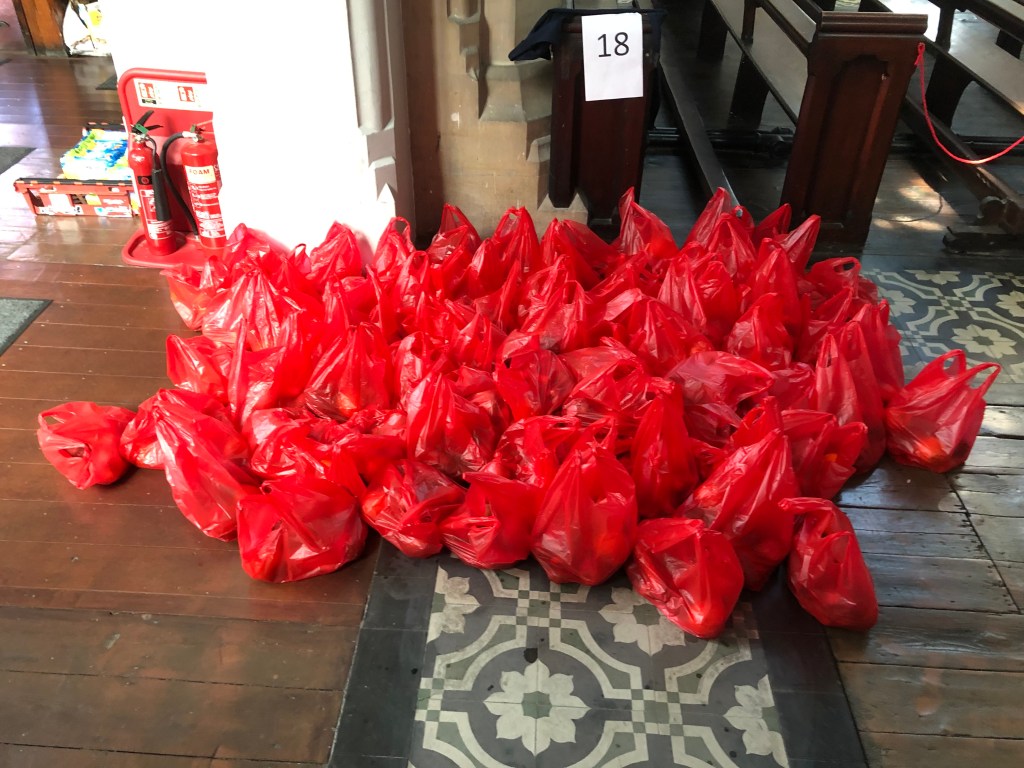
Micah Liverpool’s bags of packed vegetables and fruit ready for distribution at St. Vincent’s Church
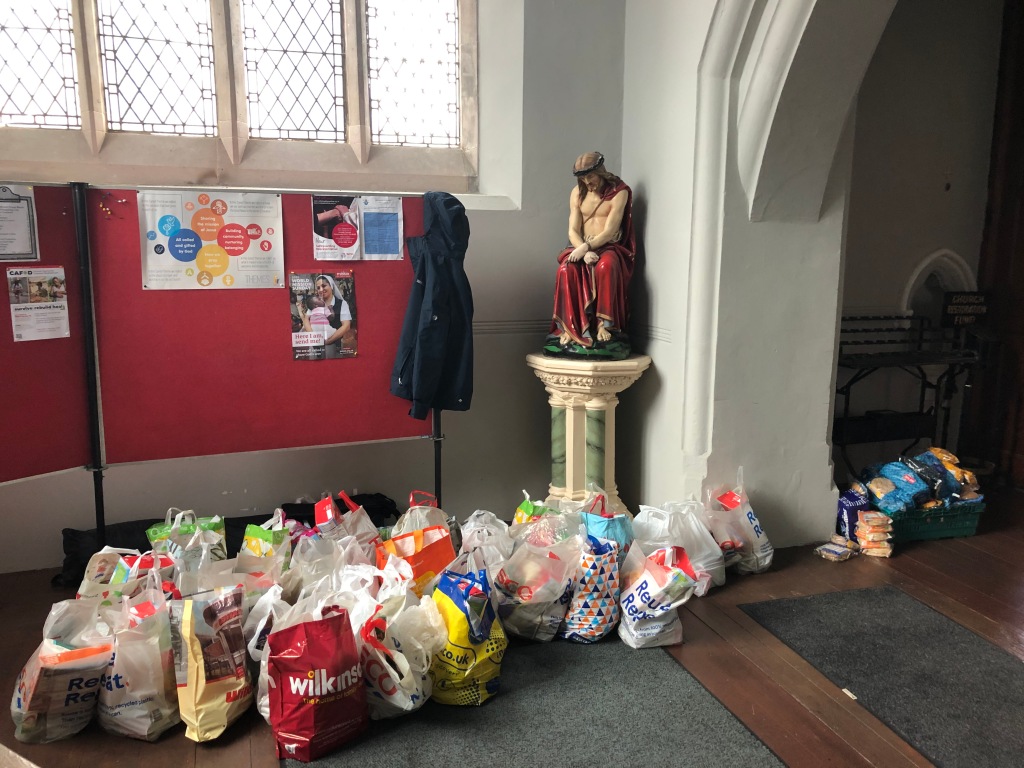
In one sense, I don’t think Micah Liverpool has ever found itself in the situation it finds itself at the moment. The necessity of delivering food parcels each week to sometimes over five hundred folks a week demands tremendous energy and time from so many.
Covid-19 stopped so many things–but even in the guidance during lockdown one, church-related food banks were allowed to continue to operate, of course dependent on good safety precautions. Micah hasn’t missed a week since lockdown one, nor had any outbreak, thanks to our safety protocols (but would someone please touch wood!).
We stand now on the precipice on what “the new normal” will look like. The pandemic has indeed changed so many things long-term. And Micah will be no exception. Plans are afoot regarding how we will respond to need long term once restrictions do lift, in addition to emergency food aid, particularly how we will respond to the increase in joblessness as a result of the pandemic.
So Micah stands at a time of great change, yet continues, as it has done, to address the age old problem of the brokenness of our world. For Christians, this is a constant demand of Christ, and that we witness to him in seeking to do our bit in making the world a better place.
As Jesus promised, poverty is still among us: “you will always have the poor with you” (John 12:8). Covid has not changed that, in fact, it’s only exacerbated inequalities among rich and poor, white and people of colour, male and female, citizen and refugee. As far as scripture is concerned, this is, I believe, a long-term result of the curse of Genesis: the enmity between the man and the woman means for us today that our relationships with each other are not as they should be, or as God intended them to be. They fall short of the vision of shalom God has for everyone.
We are working towards a kingdom that isn’t here yet, and probably will be a while. The work of feeding the hungry is such an important ministry and so inherent to the Gospel, yet even that work operates in a fallen creation. We won’t always be able to do what we’d like to. We will have stumbling blocks. We will have to wait for restrictions to change a few weeks longer than we originally had hoped.
It takes faith to hold on to the promise that there will be brighter days ahead. We can take heart that through the communion of saints, we aren’t alone in holding on. The church has always been reconsidering and responding to the needs and events of her surroundings. In fact, it’s always the duty of the church on earth to “[bring] the grace and truth of Christ to this generation”, as we are tol, in the preface to the service of the installation of a canon. We continually work out what the Gospel means as the world changes. And we do it together with the church across time and space, in an eschatological hope for what God has in store for us in the future. It is a continual offering to God in response to his continual call, for his continual glory.
AMDG
Thanks for reading this update on my missionary blog! I’m a missionary of The Episcopal Church, serving in Liverpool, UK. Make sure to subscribe at the bottom of the home page to get an email when I next post an update. God bless, and thank you!
Eager to read more? Check out the “Meet the YASCers” page of the website of the Young Adult Service Corps (YASC) of the Episcopal Church to find the blogs of my missionary colleagues: https://www.episcopalchurch.org/YASC/meet-yascers.
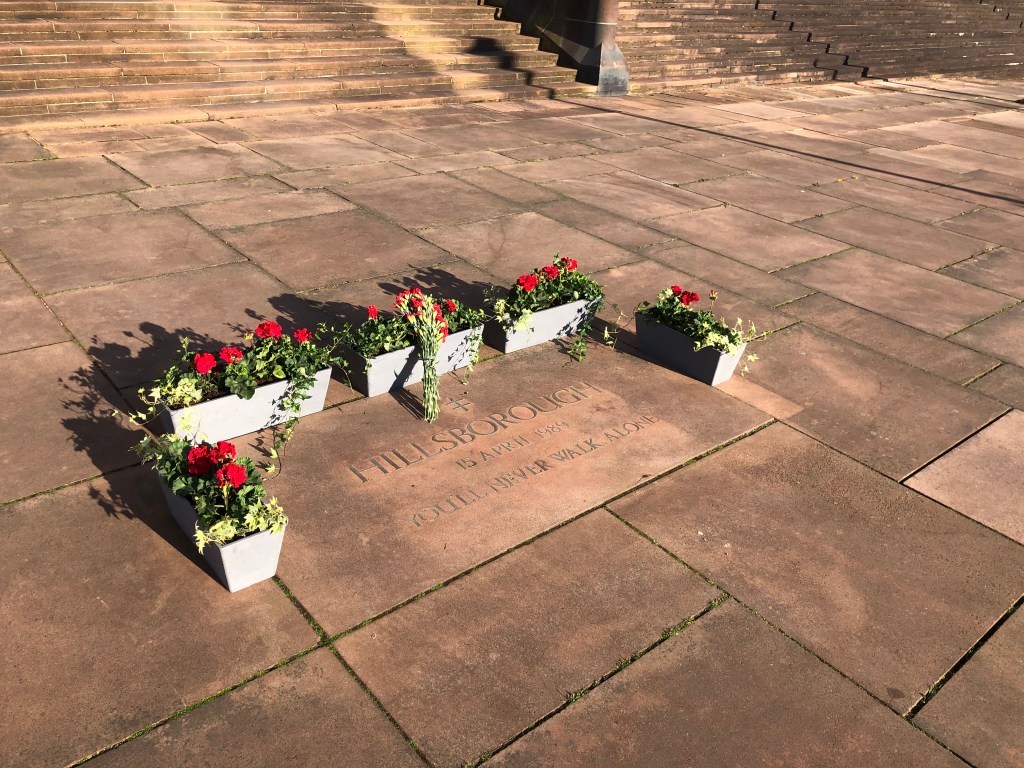
The Hillsborough Memorial outside Liverpool Cathedral
Last week at the Cathedral saw us remembering quite a bit. We were, of course, in mourning following the death of His Late Royal Highness, the Prince Philip, Duke of Edinburgh. We prayed for the repose of his soul at each of the offices and Eucharists of the daily round throughout the week, culminating in Philip’s funeral at St. George’s Chapel, Windsor, and a service of Choral Evening Prayer on Sunday the 18th in our Cathedral attended by the Lord Lieutenant (Her Majesty’s representative in Merseyside) and other dignitaries.
Thursday the 15th — in the midst of this remembering and mourning week — also saw us remembering the Hillsborough Disaster. We prayed at all services that day for the 96 victims, their families, and the knock-on effects of the disaster. And the Hillsborough Memorial outside was a focus of prayer at 3pm that day, suitably decorated with red flowers.
And now we find ourselves in the after-time, if you will, of remembering and mourning. As vaccinations continue to take place here and around the world, there’s a sense of hope and possibility that continues to warm the heart, perhaps concurrent with the return of warmer Spring weather here in the UK.
I’m also finding myself unable to fully let go of lockdown life. As much as I look forward to socialisation and travel (two things I have never missed before now), I also feel a responsibility to remember the pandemic. And to continue to remember it, beyond the process of restrictions being lifted.
Lockdown has reminded us of many things “the hard way.” Perhaps among the most important is to remember the idea that Jesus taught us so long ago:
Jesus answered them, “Beware that no one leads you astray. For many will come in my name, saying, ‘I am the Messiah!’ and they will lead many astray. And you will hear of wars and rumours of wars; see that you are not alarmed; for this must take place, but the end is not yet. For nation will rise against nation, and kingdom against kingdom, and there will be famines and earthquakes in various places: all this is but the beginning of the birth pangs. (Matthew 24:4-8).
Covid-19 has reminded us that the world is indeed broken. I think many of us knew that beforehand, but Covid-19 has — literally — stopped us in our tracks, and forced us, as a global, to work together to stop the spread of a disease that is a threat to all of us, but especially to the most vulnerable among us.
Jesus warned us, and Covid-19 has reminded us, that the world is broken, and it will wreak havoc as a matter of course. None of us, especially not Jesus’ followers in the Church, are immune from the pain and hurt of the world.
As we cautiously step beyond the pandemic, and entrust the departed to God’s care, we cannot forget the broken reality in which God has placed us. That shouldn’t depress us; it should call us to action, and remind us to do all we can to bind up each other’s wounds as we walk each other home.
YNWA
Thanks for reading this update on my missionary blog! I’m a missionary of The Episcopal Church, serving in Liverpool, UK. Make sure to subscribe at the bottom of the home page to get an email when I next post an update. God bless, and thank you!
Eager to read more? Check out the “Meet the YASCers” page of the website of the Young Adult Service Corps (YASC) of the Episcopal Church to find the blogs of my missionary colleagues: https://www.episcopalchurch.org/YASC/meet-yascers.
Probably the most agonizing promise in the whole of Scripture is Jesus’ foretold return, as John the Revelator proclaimed in His voice: “Sure, I am coming soon” (Revelation 22:20b). It is with this phrase, followed by a final doxology, that John concludes his Revelation, and since the fourth century, the whole narrative of Scripture for the Christian Church. But unlike early Christians, Christians two millennia on know that it will probably be a while yet before the Second Coming actually comes.
And more to the point: we don’t know when it is coming: “But about that day and hour no one knows, neither the angels of heaven, nor the Son,but only the Father.” (Matthew 42:36).
Jesus left us an important instruction regarding the end times: keep awake.
“Keep awake therefore, for you do not know on what dayyour Lord is coming. But understand this: if the owner of the house had known in what part of the night the thief was coming, he would have stayed awake and would not have let his house be broken into. Therefore you also must be ready, for the Son of Man is coming at an unexpected hour” (Matthew 24:42-44).
So we have to act like the end is coming just around the corner, even if we know it may not be for a bit.
Does that attitude sound familiar?
Many of us can appreciate the agony of patiently and fervently waiting for something that is still a ways away: the almost mythic-sounding easing of lockdowns, wide-spread vaccinations, and opportunities to interact with others face to face.
The agony of the past year is akin to the agony Christians have experienced for two millenia. We, like in lockdown, must wait, and more importantly prepare for when this world is over and we face the merciful judgement of God.
Here’s the key to doing well at the last judgement: make sure you have kept awake. We may be waiting for the end times, as may be God, but we aren’t supposed to be sitting at a table with anxiety for thousands of years. The Christian call to wait is also a call to action.
“Once Jesus was asked by the Pharisees when the kingdom of God was coming, and he answered, “The kingdom of God is not coming with things that can be observed; nor will they say, ‘Look, here it is!’ or ‘There it is!’ For, in fact, the kingdom of God is among you” (Luke 17:20-21).
God is already at work among us! Like the labourers in the field, there’s plenty for us to do. But Matthew provides us with a final warning-parable we ought to take note of before picking up our shovels. In the parable, Jesus tells the story of a landowner who hires labourers for his field throughout the day, yet pays each the same daily wage. The workers, however,
“grumbled against the landowner,saying, ‘These last worked only one hour, and you have made them equal to us who have borne the burden of the day and the scorching heat.’ But he replied to one of them, ‘Friend, I am doing you no wrong; did you not agree with me for the usual daily wage?Take what belongs to you and go; I choose to give to this last the same as I give to you. Am I not allowed to do what I choose with what belongs to me? Or are you envious because I am generous?So the last will be first, and the first will be last” (Matthew 20:11b-16).
There’s so much to do that there’s a place for everyone in God’s kingdom. God values all the varying contributions from different folks according to different abilities and varieties of gifts.
And pray tell: what does that kingdom look like? Right now, even during lockdown, how do we prepare for both the world beyond Covid-19, and more importantly, the world beyond this life?
I think Mary said it best:
“His mercy is for those who fear him from generation to generation. He has shown strength with his arm; he has scattered the proud in the thoughts of their hearts. He has brought down the powerful from their thrones, and lifted up the lowly; he has filled the hungry with good things, and sent the rich away empty.” (Luke 1:50-53)
Let’s get busy.
For, “Surely I am coming soon.”
Thanks for reading this update on my missionary blog! I’m a missionary of The Episcopal Church, serving in Liverpool, UK. Make sure to subscribe at the bottom of the home page to get an email when I next post an update. God bless, and thank you!
Eager to read more? Check out the “Meet the YASCers” page of the website of the Young Adult Service Corps (YASC) of the Episcopal Church to find the blogs of my missionary colleagues: https://www.episcopalchurch.org/YASC/meet-yascers.
I was recently invited to blog on the Cathedral website and on the Cathedral’s prayer blog, Prayer for Liverpool (www.prayerforliverpool.org). I thought that I would also share it with the readers of my own blog as well.
If you’re like me, and you have been known to look far too ahead in the calendar every now and again, then perhaps you, also like me, have been somewhat troubled by the fast approaching season of Lent on 17 February. My first reaction when I realized that Lent was so close was, What? Lent is beginning? I thought it never ended!
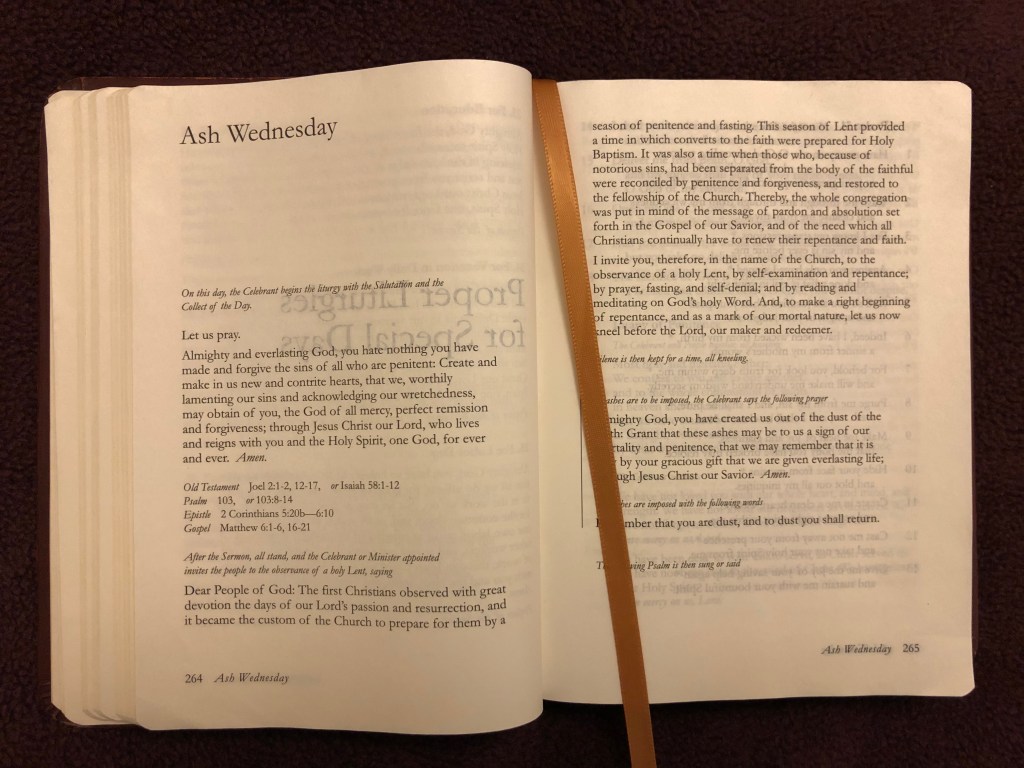
Lent is a time, according to the Book of Common Prayer 1979 of the Episcopal Church, USA (BCP 1979), for: “self-examination and repentance… prayer, fasting, and self-denial; and… reading and meditating on God’s holy word” (p. 264). By this definition, then, the changes to our world, our communities, and particularly our Churches are not synonymous with an extended Lenten observance—despite what I may have felt.
Lent is an opportunity to observe a discipline (giving up chocolate, making time for prayer, donating to charity, etc.) for its own sake. Lent, rather, is a means to an end. Again, let me quote the BCP 1979: “The first Christians observed with great devotion the days of our Lord’s passion and resurrection, and it became the custom of the Church to prepare for them by a season of penitence and fasting. This season of Lent provided a time in which converts to the faith were prepared for Holy Baptism. It was also a time when those who, because of notorious sins, had been separated from the body of the faithful were reconciled by penitence and forgiveness, and restored to the fellowship of the Church. Thereby, the whole congregation was put in mind of the message of pardon and absolution set forth in the Gospel of our Savior, and of the need which all Christians have to renew their repentance and faith” (pp. 264-265).
So Lent, then, is a time of preparation for the solemn and holy observances of Holy Week and Easter. It is a time of discernment for those wishing to enter the Church. It is a time for profound repentance for wrongs committed to others. And it is time of a reminder of our need as Christians continually to repent, and to hold fast to the faith.
Lent is not, then, an extended period of not being able to meet together due to a highly contagious and deadly virus. Covid-19 is not a punishment for the sins of the world, or for the existence of religions other than Christianity. It is not a personal return from the Almighty for the sins of our own pasts. The austerity and profundity of denial associated with Lent may seem to have been extended beyond last Spring. But Lenten discipline is not suffering for its own sake, or suffering under the situation in which we all find ourselves. Lent is about the heart. About what taking a fearless moral inventory of where we are in relation to God and those around us. And is particularly set aside for correcting what may be in need of correction. Lent is a time for us, pandemic or not, to consider how we might better show the light of Christ in the world, which we have been contemplating in this season of Epiphany. Lent is for glad apologies and purposeful amendments.
Now having said that, that doesn’t mean we haven’t suffered during the pandemic. We have. Some of us who are key workers are exhausted physically, mentally, and emotionally. Others who are shielding are facing isolation and loneliness for almost a year. And those who are in need in regular times find their need compounded by the inability to cover bills or find help.
Lent’s invitation to us is a time to prepare ourselves to meet our Saviour at the cross. Who better to show us the broken reality of the world than our Lord and Saviour, who in his death on the cross not only gave us hope, but an honest testimony to the severity of the world whose power we are called to resist by keeping that hope alive. Christ gives us hope that the suffering of the present is not going to be the final word on our future.
So. Lent 2021. What’s a Christian to do? We could start by considering ways in which we aren’t doing so well. Even at home, we can worship God, we can support our neighbours, we can contribute to good in the world, we can care for ourselves, and give all of that and more a trial run or rethink if need be. We can face the reality of the crucified and risen Saviour with more depth and seriousness if we have prepared for it deeply and seriously. We can more closely follow the pattern of our Saviour when we try to follow his example of shedding light in the darkness.
So, as the BCP says, “I invite you, in the name of the Church, to the observance of a holy Lent…” (p. 265).
Thanks for reading this update on my missionary blog! I’m a missionary of The Episcopal Church, serving in Liverpool, UK. Make sure to subscribe at the bottom of the home page to get an email when I next post an update. God bless, and thank you!
Eager to read more? Check out the “Meet the YASCers” page of the website of the Young Adult Service Corps (YASC) of the Episcopal Church to find the blogs of my missionary colleagues: https://www.episcopalchurch.org/YASC/meet-yascers.
The 28th of December saw my first attempt at making roast beef — and spending the night in the hospital.
To be concise, I had swallowed a piece of beef that went down my food tube but not below the base of my throat, so I was unable to swallow anything else (including saliva). I was taken to A&E by Canon Neal and his wife Stella (who, honestly, deserve gold medals) after I had been repeatedly unable to dislodge what was in my throat. I wasn’t in pain, per say, just supremely uncomfortable.
It eventually went down of its own accord, after I was admitted to a ward and caught a few hours sleep, having been administered a muscle relaxant. I therefore avoided having to undergo an endoscopy to remove the offending piece of beef.
The picture above was taken about 3am Sunday morning on the 29th. The A&E doctor had just recommended the endoscopy and we were getting ready to walk me to a bed. I took this photo of my IV drip, which I was given to counteract the dehydration caused by not being able to swallow. I must have been pretty out of it, as I called it my “wall juice”.
Later on, I was attended by two very nice ward nurses who kept watch over me in the early hours of that morning before being discharged. They knew that I was a religious worker, and one said to me, “Trust in God, he will take care of you. Don’t worry, you’ll be all right.” I appreciated this gesture and word of encouragement during what was a, shall we say, trying evening.
But I also remember thinking how presumptive and a bit offensive I found the comment. Of course, I never said any of this out loud, but I remember thinking, You don’t really need to tell me to trust God. I already do. How do you think I have stayed sane throughout this whole fiasco so far? I also asked myself later that night, Wait, where is God in all of this? I know intellectually and even personally of God’s love for me, regardless of my current situation. But what is that love supposed to feel like? Did the nurse think that I wasn’t trusting in God enough that she felt the need to say that?
And here we have an age-old theological dilemma: trusting in a powerful, loving God even if he is unseen.
I look back now and think how silly I was for being offended at a well-intentioned and theologically apt word from the nurse, as well as the worry over what I thought I was supposed to feel. I can look back quite easily now and see God’s love at work behind the care of the excellent NHS staff at the Royal that night, as well as God’s call to me to remain calm and connected by reading the Offices of Compline and Morning Prayer to keep some sanity in a trying situation, as well as all others who have helped me out during and since my hospital stay.
I see God at work throughout the whole business, now, not in a flashy or miraculous sort of way, but in the quiet, ordinary-yet-extraordinary people and events that had me home early afternoon on Sunday: good neighbours, wonderful doctors and nurses, a muscle relaxant, a novel, Daily Offices, a bed, sleep, and tea and toast. An IV drip of “wall juice” for both hydration and humour during a long night.
I don’t recommend hospital stays for their particular comfort. But I do recommend the calm, ordinary mercies of God that are daily visited on us.
Trust me, they’re unforgettable.
But more importantly, trust God.
Thanks for reading this update on my missionary blog! I’m a missionary of The Episcopal Church, serving in Liverpool, UK. Make sure to subscribe at the bottom of the home page to get an email when I next post an update. God bless, and thank you!
Eager to read more? Check out the “Meet the YASCers” page of the website of the Young Adult Service Corps (YASC) of the Episcopal Church to find the blogs of my missionary colleagues: https://www.episcopalchurch.org/YASC/meet-yascers.
Photo caption: Pre-packed food parcels ready to go at St. Vincent’s
As I write, I’m about to enter my third month in my new incarnation as a Tsedaqah Community Member. In my role in the Micah Liverpool food bank charity, I have the pleasure of serving as the contact point between volunteers and charity staff; writing thank you notes on behalf of the charity, as well as answering general inquiries from the public, in addition to serving as supervisor to the Food Bank pantry sessions on Tuesdays and Thursdays.
Integral to the way that Micah operates as a charity is humility. By now, I’ve probably quoted Micah 6:8 to death, but I will again, because it’s really important: “He has told you, O mortal, what is good; and what does the Lord require of you but to do justice, and to love kindness, and to walk humbly with your God?” When we walk with God and try to follow Jesus, what we do in his name has to be informed, among other things, by humility.
Giving is important. But how and why we give might be even more important. We can give out of our abundance and generosity. But Jesus shows us that it is more blessed to give out of our poverty. What this doesn’t mean is to give, and by giving, develop a habitual feeling or superiority. Jesus doesn’t justify the righteousness of people who praise themselves because of their good works.
You will often hear the officiant of Morning or Evening Prayer at Liverpool Cathedral to pray about the offering of oneself and all that one does during the day to God. When I’ve prayed this as the officiant, I always add something along the lines of, “Help us to remember that all we do, we do to your glory, and to yours alone.”
The food that is donated to us isn’t ours. It’s God’s. The work we do isn’t ours, it’s really God’s. God cares for each and every one of us, and intends the flourishing of all humanity. Our Food Bank pantry sessions are not a mark of how wonderful we are, but the work of God putting food in the hands of the hungry, where it should have been in the first place. Feeding the hungry is a matter of God rectifying injustice, rather than us dispensing our own justice.
And it’s absolutely essential. One of Jesus’s commands that have come down to us in Holy Scripture that means more or less the same thing now as it did 2,000 years ago is to feed the hungry. We feed the hungry–humbly–because doing so is a hallmark of our Christian calling. It is a hallmark of how God works in the world.
And it brings God’s kingdom closer.
When I work in the vegetable packing area during Food Bank sessions, I often am overtaken as I perform the repetitive task of placing potatoes, onions, carrots, peppers, and fruit in bags over and over again for individual consumption. I can sometimes feel the sense of daring holiness, a sense that the Kingdom of God has inched closer as each bag is filled and brought out to the tables to be offered.
While this work is incredibly rewarding, it can be incredibly depressing. After a busy pantry session, the happy exhaustion can also be mixed with sadness. In 2020 in the modern West, we still have a need for Food Banks. There are still poor and hungry people on our streets. Justice is still denied. The work of the foodbank, for me, was best described by a regular donor, who said that: “Unfortunately, it’s a pleasure.”
Jesus, for all he promised, never said that following him would be easy. In fact, he said the opposite. But what’s really important to remember is that we aren’t following Jesus alone. We follow Jesus together. As Liverpool Cathedral, as Liverpool Diocese, as the Church of England, as the Anglican Communion, as the entirety of the Jesus Movement. We work together and rely on each other when the cards are up and down, and especially when they are down.
Jesus knew what it was to suffer. The community that follows him will know that too and work together beyond it.
Thanks for reading this update on my missionary blog! I’m a missionary of The Episcopal Church, serving in Liverpool, UK. Make sure to subscribe at the bottom of the home page to get an email when I next post an update. God bless, and thank you!
Eager to read more? Check out the “Meet the YASCers” page of the website of the Young Adult Service Corps (YASC) of the Episcopal Church to find the blogs of my missionary colleagues: https://www.episcopalchurch.org/YASC/meet-yascers.
I am excited to announce that I have been approved to spend another year in mission as a member of the Young Adult Service Corps placed in the Tsedaqah Community in the Diocese of Liverpool. My role will shift on emphasis a bit in the coming year, but retain the core foundations of my work this year. In the coming year, I will:
Serve as the Food Support Officer for the Micah Foodbank, Liverpool Cathedral’s hunger ministry, assisting in administrative work as well as coordinating volunteers who help run the two Foodbank sessions each week (that have operated throughout the pandemic!)
Publish academic work with the Canon Theologian concerning questionnaire results from a survey conducted last Christmas in the Cathedral
Continue to assist in various administrative duties in the Dean’s Office
Continue to worship in the Cathedral, where I assist at the altar, as well as participate in and help to lead the Daily Offices.
It has been a privilege to continue to serve as a missionary throughout the coronavirus pandemic. I am humbled to have been able to play a small part in the mission of the Church in these particularly troubling and challenging times. Thank you all for your continued prayerful and other support throughout this year.
The Global Mission Office of the Episcopal Church again requires me to fundraise $10,000 towards this year of mission. The pandemic has affected all of us in so many ways, but if you are able, I would invite you to support my second year of mission monetarily. There are two ways to contribute financially. One is by sending a check made out to St. Mary’s Episcopal Church and marked “Nelson Pike YASC” in the memo line, which you can mail to:
St. Mary’s Episcopal Church
P.O. Box 299
Rockport, Massachusetts
01966
Another way to contribute financially is to use the giving portal on the St. Mary’s website, the link to which is here: http://stmarysrockport.org/. Click on the link at the top of the website that says, “We are now accepting donations using PayPal!” When prompted to specify the purpose of the donation, please indicate “N. Pike YASC” where you can “Add a Note” to your donation.
You all remain in my prayers as we all continue to follow Christ through this pandemic and beyond.
With gratitude,
Nelson
Thanks for reading this update on my missionary blog! I’m a missionary of The Episcopal Church, serving in Liverpool, UK. Make sure to subscribe at the bottom of the home page to get an email when I next post an update. God bless, and thank you!
Eager to read more? Check out the “Meet the YASCers” page of the website of the Young Adult Service Corps (YASC) of the Episcopal Church to find the blogs of my missionary colleagues: https://www.episcopalchurch.org/YASC/meet-yascers.





 Christ's Mission in Liverpool